What is the Best Electric Dirt Bike in 2026? Ultimate US Buyer’s Guide

What is the best electric dirt bike

The dirt bike world is in the middle of a seismic shift. Riders across the US are swapping carbureted two-strokes and thumping four-strokes for silent, torque-heavy electric machines that rip off the line harder than anything combustion-powered in their class. If you are searching for the best electric dirt bike in 2026, you have already sensed the momentum. Modern e-motos deliver instant, clutchless torque that pins you to the seat from zero RPM, with no gear changes, no warm-up rituals, and no ear-splitting exhaust note to anger your neighbors.

But the market is flooded with overhyped specs, inflated range claims, and flashy marketing. This guide cuts through all of it. You will get real-world performance data, honest pros and cons, and a clear recommendation for every type of rider and budget. No fluff. Just facts.


Why Electric Dirt Bikes Are Taking Over US Trails

Why Electric Dirt Bikes Are Taking Over US Trails

Adult riders across America are ditching their gas bikes faster than ever, and three big reasons keep coming up.

The first is instant torque. Electric motors deliver 100% of their torque from the moment you twist the throttle. There is no clutch to slip, no powerband to hit, and no gear to miss. You point and shoot. For trail riders navigating technical rock sections or motocross riders launching out of corners, that immediate, linear power delivery is a serious performance advantage over any comparable gas bike.

The second is zero noise. This is not just a comfort feature. Trail closures across the US are frequently linked to noise complaints from nearby residents and land managers. Electric bikes operate at a fraction of the decibels of a gas engine, which means more trail access, more riding hours, and far fewer confrontations at the trailhead. Neighborhoods that were off-limits with a loud gas bike become perfectly viable with an electric.

The third is virtually zero maintenance. Forget oil changes, air filter cleaning, jetting carburetors, top-end rebuilds, and valve adjustments. Electric drivetrains have a fraction of the moving parts of a combustion engine. Your maintenance checklist shrinks to brake pads, tire pressure, chain tension, and keeping the battery charged. Over three years of riding, that difference in time and money is enormous.


Top 5 Best Electric Dirt Bikes on the Market Right Now

Top 5 Best Electric Dirt Bikes on the Market Right Now

1. Stark Varg — Best for Pure Motocross Performance

The Stark Varg is the bike that finally forced the motocross world to take electric seriously. Built from the ground up as a racing machine, it produces 80 horsepower and weighs just 110 kg, making it lighter than most 450cc gas competitors. The Varg is not trying to be an entry-level e-bike. It is a full-send race weapon with an app-adjustable power map that lets you dial in feel for any track condition.

Pros:

  • 80 hp with fully adjustable power delivery via smartphone app
  • Lightest full-power electric motocross bike available in 2026
  • Race-spec KYB suspension front and rear
  • Swappable battery system for extended riding sessions
  • Ridden by professionals in multiple national-level competitions

Cons:

  • Premium price tag puts it out of reach for casual riders
  • Battery range on full-power MX track use is approximately 1 to 1.5 hours
  • Spare batteries are expensive and add significant cost
  • Overkill for trail or recreational use

Best for: Serious motocross racers and performance-obsessed riders who have the budget to match their ambition.

2. E Ride Pro SS 3.0 — Best for Speed and Range

The E Ride Pro SS 3.0 is built for riders who want the full package: serious top speed, respectable range, and a chassis that handles both trail and track duty without compromise. With a 72V architecture and a large-capacity battery, it consistently outperforms rivals in real-world range tests, making it the pick for riders who spend long days in the saddle rather than quick 45-minute sessions.

Pros:

  • Best-in-class range for extended trail riding sessions
  • High voltage 72V system delivers strong sustained power output
  • Comfortable ergonomics suit taller and heavier adult riders
  • Strong aftermarket support and parts availability in the US
  • Competitive pricing relative to its performance level

Cons:

  • Heavier than the Stark Varg, which affects technical trail agility
  • Not purpose-built for motocross track use
  • Charging time can be lengthy without an upgraded fast charger

Best for: Adult trail riders and all-day adventure seekers who prioritize range and comfort over razor-edge motocross performance.

3. Sur-Ron Light Bee X — Best for Modding and Value

Few electric dirt bikes have built a cult following as rapidly as the Sur-Ron Light Bee X. At its price point, nothing else comes close in terms of performance, reliability, and the sheer depth of the aftermarket modification community surrounding it. Riders have transformed stock Light Bees into fire-breathing trail monsters with battery upgrades, motor controllers, and suspension components. If you enjoy wrenching and customizing, this is your canvas.

Pros:

  • Extremely accessible price point for entry-level to mid-range budgets
  • Massive global mod community with endless upgrade paths
  • Lightweight at around 50 kg, making it nimble on tight singletrack
  • Excellent build quality and proven long-term reliability
  • Great option for younger or smaller-statured adult riders

Cons:

  • Stock power output is modest compared to full-size electric bikes
  • Not suited for aggressive motocross or high-speed open terrain in stock form
  • Smaller battery limits range without an aftermarket upgrade
  • Classified as an off-road vehicle in most US states

Best for: Budget-conscious riders, modding enthusiasts, and anyone stepping into electric off-road riding for the first time.

4. Talaria Sting R — Best for Technical Trails

The Talaria Sting R carved out its reputation on technical singletrack where precise throttle control and low-speed maneuverability matter more than peak horsepower. Its mid-drive motor configuration gives it a lower, more centralized center of gravity compared to hub-drive competitors, and riders consistently praise the smooth, predictable power delivery that inspires confidence on sketchy terrain. Think rooty forest trails, rock gardens, and tight switchbacks.

Pros:

  • Mid-drive motor delivers exceptional low-speed torque and control
  • Lower center of gravity improves handling on uneven terrain
  • Strong range figures on technical trail riding at moderate throttle
  • Competitive pricing in the mid-range electric segment
  • Active and responsive manufacturer for firmware updates

Cons:

  • Less peak power than the Stark Varg or E Ride Pro at wide-open throttle
  • Suspension is adequate but not as premium as race-spec competitors
  • Heavier riders above 220 lbs may notice reduced performance

Best for: Technical trail riders, enduro enthusiasts, and anyone who values precise low-speed control over raw top-end speed.

5. Altis Sigma — Best Heavy-Duty Newcomer

The Altis Sigma arrived with bold claims and has largely backed them up. Designed with heavier riders and demanding terrain in mind, it features a reinforced frame, heavy-duty suspension components, and a battery system engineered for sustained power delivery rather than flashy peak numbers. It is the newest name on this list, but the engineering team behind it has serious credentials, and early owner reports are consistently positive.

Pros:

  • Frame and suspension engineered to handle riders up to 260 lbs confidently
  • Above-average battery capacity for extended ride sessions
  • Solid build quality with attention to water and dust resistance
  • Competitive warranty and US-based customer support
  • Strong value proposition for larger or more aggressive riders

Cons:

  • Newer brand means less long-term reliability data than Sur-Ron or Talaria
  • Heavier overall weight compared to lighter competitors in its class
  • Aftermarket parts availability is still developing

Best for: Heavier riders, aggressive trail bashers, and those who want a durable platform that is not afraid of rough use.

Crucial Factors to Consider Before Buying

Crucial Factors to Consider Before Buying

Choosing the right electric dirt bike comes down to matching specs to your actual riding style. Here is what every buyer should understand before handing over money.

Voltage and Amp Hours (Ah) — These two numbers define your battery. Voltage (V) is the pressure of the electrical system. Higher voltage means more potential power. Amp hours (Ah) measure how much energy the battery stores, which directly affects range. A 72V 40Ah battery holds significantly more energy than a 60V 32Ah pack. Think of voltage as the width of a pipe and Ah as the size of the tank behind it. When comparing bikes, multiply volts by amp hours to get watt-hours (Wh), the universal measure of battery capacity.

Peak vs Nominal Power — Manufacturers love advertising peak kilowatt figures because they sound impressive. Peak power is what the motor can deliver for a few seconds during hard acceleration. Nominal power is the continuous output it can sustain without overheating. A bike claiming 15 kW peak might only sustain 8 kW continuously. For trail riding and hillclimbing, nominal power is the number that actually matters. Always look for both figures before buying.

Suspension Quality — Budget electric bikes often cut costs on suspension, fitting basic coil-over forks and a mono-shock with limited adjustability. If you plan to ride anything beyond flat fire roads, invest in a bike with quality suspension. Look for adjustable compression and rebound damping as a minimum. Race-level bikes like the Stark Varg use premium KYB components. Mid-range bikes vary widely, so read owner reviews specifically about suspension performance on rough terrain.

Rider Weight Limits — This is the most underappreciated spec in electric dirt bikes. Every advertised top speed and range figure is tested at a specific rider weight, usually around 150 to 165 lbs. If you weigh 200 lbs or more, expect your real-world top speed to be noticeably lower and your range to shrink by 15 to 25 percent compared to published figures. Heavier riders should specifically seek out bikes rated for their weight and look at models like the Altis Sigma that are built with larger riders in mind.

The Hidden Truth About Street Legality in the US

The Hidden Truth About Street Legality in the US

One of the most common questions new electric dirt bike buyers ask is whether they can ride their new bike on public roads. The short answer is: probably not, and assuming otherwise can be costly.

In the US, any vehicle operated on public roads must meet federal and state safety standards. Off-highway vehicles (OHV) are built and certified exclusively for off-road use. They typically lack the required lighting, turn signals, mirrors, horn, and DOT-rated tires that street-legal vehicles must have. The fact that a bike is electric does not change this classification at all.

Adding mirrors and turn signals to your Sur-Ron does not automatically make it street legal. Many states require the manufacturer to certify the vehicle as meeting federal motor vehicle safety standards, which an OHV never will. Some states classify low-power electric two-wheelers as mopeds or electric bicycles under specific watt thresholds, which may allow limited road use. Others are far stricter. Laws vary dramatically by state, and in some jurisdictions, riding an unregistered OHV on a public street can result in impoundment and a significant fine. Always check your specific state’s DMV regulations before assuming any dirt bike is road-legal.

Gas vs Electric: Which is Actually Cheaper?

Gas vs Electric Which is Actually Cheaper

Electric dirt bikes cost more upfront. That is the honest truth, and anyone telling you otherwise is selling something. A comparable gas 250cc or 450cc motocross bike typically runs $5,000 to $10,000 new, while quality electric alternatives start around $8,000 and climb steeply for performance models. However, the total cost of ownership over three years tells a very different story.

CategoryElectricGasWinner
Upfront Cost$8,000–$14,000$5,000–$10,000Gas wins
Annual Fuel$0$300–$600Electric wins
Oil ChangesNone$150–$300/yrElectric wins
Engine RebuildNone$500–$2,000Electric wins
Brake/TiresSimilarSimilarTie
3-Year Total~$9,000–$15,000~$7,500–$14,000Close / Electric wins long-term

Gas bikes require premium fuel at every session, oil changes every few rides, air filter maintenance, coolant flushes, and eventual top-end engine rebuilds that can run $500 to $2,000 or more depending on the bike and the mechanic. Electric bikes need virtually none of that. Charge the battery, check the chain, inspect the brakes, and ride.

For a rider putting in 50 to 100 hours per year, the electric option typically reaches cost parity with a comparable gas bike within two to three years, after which the savings compound. If you plan to own your bike for more than three years, electric almost always wins on total cost.

Frequently Asked Questions

How fast do electric dirt bikes go?

Most full-size adult electric dirt bikes reach 50 to 80 mph depending on the model and rider weight. Performance machines like the Stark Varg can exceed 80 mph. Budget models typically top out between 45 and 55 mph. Top speed drops noticeably for heavier riders above the bike’s rated weight.

How long does the battery last on a dirt trail?

Expect 1 to 2.5 hours of active trail riding depending on terrain, rider weight, and power mode. Flat, smooth trails at moderate throttle deliver the best range. Technical climbs and full-power motocross riding drain the battery significantly faster. Most quality bikes have selectable power modes to extend ride time when needed.

Are electric dirt bikes waterproof?

No electric dirt bike is fully waterproof, but most quality models carry an IP rating that protects against rain, splashing, and muddy trail conditions. Full submersion will damage any electric bike. Riding through streams or deep water crossings carries real risk of battery or motor damage and should be avoided unless the manufacturer specifically certifies water crossing capability.

Conclusion

Electric dirt bikes in 2026 are no longer a novelty. They are fast, reliable, low-maintenance machines that are rapidly closing the performance gap with the best gas bikes on the market. Whether you are a motocross racer chasing lap times or a weekend trail rider looking for an easier, quieter ride, there is an electric bike built for you.

For professionals and performance-focused riders with the budget to match, the Stark Varg remains the benchmark. Nothing else in the electric motocross space combines its power, weight, and race-proven credentials. For everyday trail riders and value-conscious buyers, the Sur-Ron Light Bee X and Talaria Sting R represent outstanding all-round packages at a fraction of the price.

What is the Best Electric Bike on the Market

What is the best electric bike on the market

Gas just hit another record high, your commute has turned into a parking lot, and you’re tired of watching your wallet drain every time you pull into a filling station. Sound familiar? You’re not alone  millions of Americans are making the switch to electric bikes, and honestly, it’s one of the smartest moves you can make right now.

But here’s what most buying guides won’t tell you upfront: there is no single “best” e-bike. The right bike for a Brooklyn delivery rider is completely different from what a Suburban dad needs for weekend trail rides  and both are worlds apart from what a college student wants for her 3-mile campus commute.

This guide cuts through the spec-sheet noise and marketing fluff. We’ve broken down the top e-bikes by real-world use case urban commuting, off-road adventure, budget builds, and cargo hauling so you can find the machine that actually fits your life, your roads, and your budget.


Understanding E-Bike Classes in the US

Understanding E-Bike Classes in the US

Before you spend a single dollar, you need to understand one thing: not all e-bikes are created equal under the law. The US uses a three-class system that determines where you can ride, how fast you can go, and whether you need a license. Get this wrong and you could end up with a bike that’s illegal on your favorite trail or worse, one that’s overkill for your daily commute.


Class 1 :Pedal-Assist Only (Max 20 mph)

Class 1 bikes provide motor assistance only when you’re actively pedaling, cutting off at 20 mph. No throttle, no coasting on motor power alone. These are the most universally accepted e-bikes in the US welcome on bike paths, multi-use trails, and most public roads in all 50 states. They feel the most like a traditional bicycle, making them a great starting point for new riders. The riding experience is natural and intuitive; the motor simply makes your pedaling effort go further.


Class 2 :Throttle-Assisted (Max 20 mph)

Class 2 adds a throttle typically a thumb lever or twist grip that propels the bike up to 20 mph without any pedaling at all. This is a game-changer for riders dealing with joint pain, steep hills, or heavy cargo loads. You still get pedal-assist modes, but the throttle option is there when you need a break. Keep in mind that some states restrict Class 2 bikes from certain bike-only paths, so always check your local regulations before you buy.


Class 3 : Speed Pedelec (Max 28 mph)

Class 3 is built for speed. Pedal-assist only (no throttle in most configurations), but it pushes you up to 28 mph  fast enough to keep pace with urban traffic. These bikes are the commuter’s weapon of choice in busy cities. The trade-off? They’re typically banned from shared recreational trails, and several states require riders to be at least 16 years old. They’re also heavier and more expensive. Worth every penny if your commute involves long, flat stretches where speed is your priority.


Top E-Bike Reviews by Category

Top E-Bike Reviews by Category

Best Overall Urban Commuter E-Bike: [Brand A Model]

If you’re looking for one bike to handle everything  rain-soaked Monday mornings, grocery runs, and the occasional spirited weekend ride the [Brand A Model] is the benchmark to beat. It ships with a 750W mid-drive motor, which delivers power more efficiently than hub motors by leveraging your bike’s existing gearing. The result is a ride that feels powerful on climbs without sacrificing smoothness on flat ground.

The 60-mile real-world range  tested on mixed terrain, not just flat roads  is genuinely impressive. Fully integrated front and rear lights run off the main battery, so you’re never scrambling for AA batteries at 6am. The standout feature, however, is the built-in 4G/GPS anti-theft tracking system. In a major US city where e-bike theft rates have surged over 300% in three years, this is no longer a luxury it’s a necessity. The companion app lets you lock the motor remotely and track your bike in real time.


Pros:

  • 750W mid-drive motor delivers smooth, efficient power across all terrain types
  • Real-world 60-mile range makes it viable for full-day use without mid-day charging anxiety
  • Integrated 4G/GPS tracking is a genuine theft deterrent  not just a marketing checkbox

Cons:

  • Premium pricing puts it out of reach for budget-conscious first-time buyers
  • At 55+ lbs, carrying it up stairs or loading onto a car rack requires real effort


The Hidden Costs of E-Bike Ownership Nobody Talks About

The Hidden Costs of E-Bike Ownership Nobody Talks About

Most e-bike reviews end at the purchase price. That’s a problem, because the true cost of ownership can be 30–50% higher than the sticker price over five years. Here’s what the glossy buying guides leave out.


Battery replacement is the big one. Lithium-ion batteries  the heart of every e-bike degrade over time. Most manufacturers quote 500–800 full charge cycles before capacity drops noticeably. For a daily commuter, that’s roughly 3 to 5 years of real-world use. Replacement batteries typically run $400–$800 depending on capacity and brand. Always check whether your battery is a proprietary pack (expensive, single-source replacement) or a standard cell configuration that third-party suppliers can service.


Brake wear is faster than you’d expect. E-bikes are significantly heavier than traditional bikes  often 50 to 70 lbs  and they travel at higher average speeds. That combination accelerates brake pad wear considerably. Budget $40–$80 per year for brake maintenance, and factor in hydraulic brake bleeds if your bike uses a hydraulic system (most quality e-bikes do).


E-bike insurance is no longer optional in major cities. With e-bikes routinely priced between $1,500 and $5,000, theft has become a major issue. Standard renters or homeowners insurance often excludes bikes over a certain value, or requires a costly rider. Dedicated e-bike insurance through providers like Velosurance or Spoke runs $100–$200 per year and covers theft, accidental damage, and liability. In cities like New York, Chicago, or San Francisco, it’s not a luxury  it’s basic financial sense.


Final Verdict: How to Choose the Right E-Bike for You

Final Verdict How to Choose the Right E-Bike for You

Stop chasing the highest wattage number and the longest spec-sheet range. The best e-bike is the one you’ll actually ride every day  and that comes down to two practical questions: Where are you going to store it, and how far do you ride on a typical day?

A 75-mile range battery is worthless if the bike is too heavy to carry up your apartment stairs. A top-of-the-line suspension fork is overkill if you’re riding smooth city asphalt. Match the bike to your real life  not your fantasy adventure  and you’ll get a machine that earns its place in your routine rather than collecting dust in a corner.


Use the class system as your legal compass, treat battery replacement as a planned expense, and take theft protection seriously from day one. Do those three things, and you’ll be miles ahead of the average buyer.


We’d love to hear from you! Drop a comment below and let us know  are you a throttle-and-go Class 2 rider, a speed-focused Class 3 commuter, or a purist who loves the natural feel of Class 1 pedal-assist? Your experience might be exactly what another reader needs to make their decision.

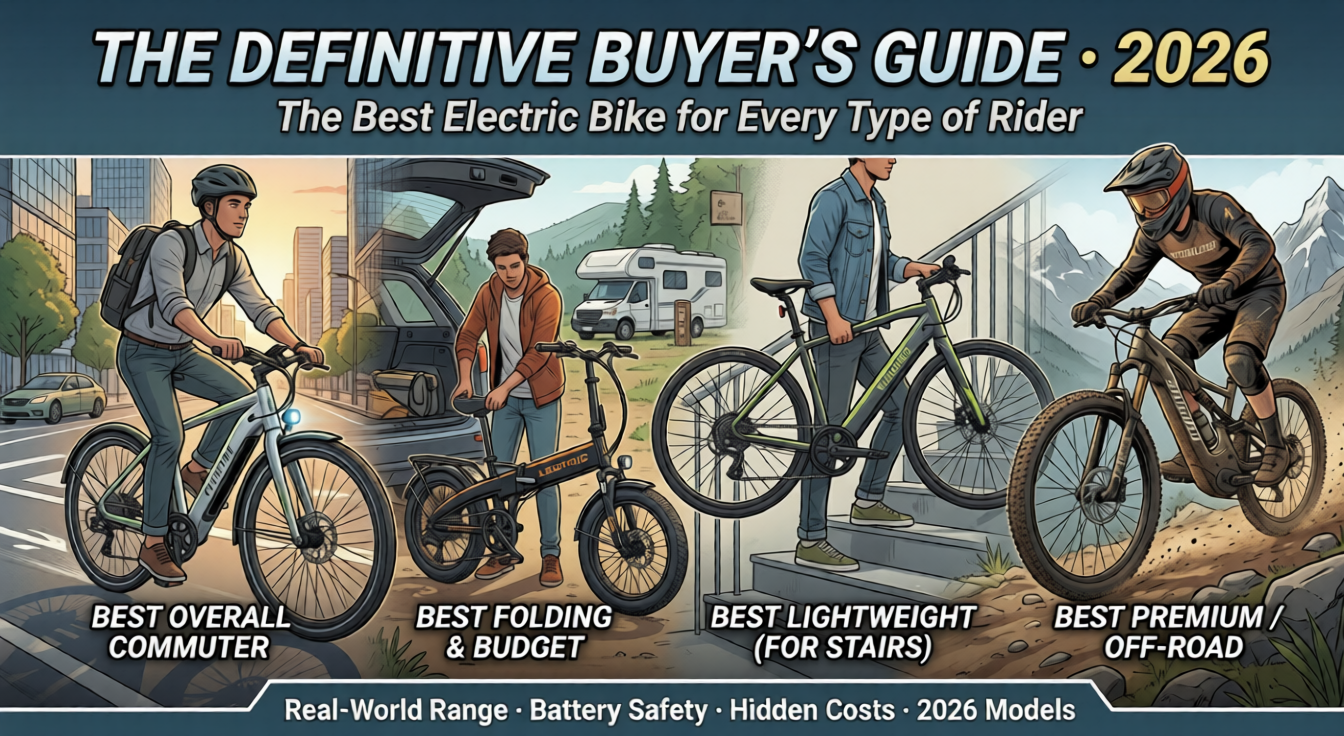
THE DEFINITIVE BUYER’S GUIDE

What is the best electric bike

The Best Electric Bike for Every Type of Rider

Real-World Range · Battery Safety · Hidden Costs · 2026 Models

The uncomfortable truth? There is no single “best” e-bike. There’s only the best e-bike for your life your storage constraints, your commute distance, your budget years down the road. Every brand claims “best-in-class,” and every spec sheet looks impressive until you’re carrying a 70 lb bike up three flights of stairs at 7 AM.

This guide cuts through the marketing hype. We examine real-world range (not manufacturer claims), battery safety certifications, local service availability, and the hidden costs that no advertisement will ever mention. Find your lifestyle category and go straight to what matters.

The 3 Things You Must Check Before Buying an E-Bike

The 3 Things You Must Check Before Buying an E-Bike

Community forums are full of buyer’s remorse. It almost always traces back to three overlooked fundamentals—not specs, not speed, not color.

⚖️  1. Bike WeightA 70 lb e-bike sounds fine until you’re carrying it up three flights of stairs. Ask yourself: where exactly will you store it? Factor that answer into every shortlist decision.🔋  2. Battery CertificationCheap batteries are a genuine fire risk. Look specifically for UL 2849 certification it tests the entire electrical system together, not just individual cells in isolation.🔧  3. Local Shop SupportIf the brand has zero local bike shop partners, a broken motor or proprietary brake means weeks of downtime. Always verify serviceability in your city before buying.

Top Picks: The Best Electric Bikes Reviewed

Top Picks: The Best Electric Bikes Reviewed

Rather than ranking bikes against each other, we’ve matched them to real lives. Jump straight to your categoryand skip the rest.

★ Best Overall Commuter E-Bike: Aventon Level 3

EDITOR’S PICK · COMMUTERAventon Level 3Best for daily riders, 8–15 mile commutes
Built for the person riding daily in rain, dark, and traffic. Integrated front and rear lights, full-coverage fenders, and a rear rack rated to 55 lbs mean you arrive with dry work clothes. The real differentiator is the torque sensor unlike cadence sensors that lurch assist on pedal spin, torque sensors read how hard you’re actually pushing and deliver smooth, proportional power that feels natural in stop-and-go city riding and on hills.
Real-world range:  45–65 mi
Weight:  ~52 lbs
Motor type:  Torque sensor hub drive
UL Certified:  UL 2849 ✓

Best Folding & Budget E-Bike: Lectric XP 4.0

Best Folding & Budget E-Bike Lectric XP 4.0
FOLDING · BUDGETLectric XP 4.0Best for RV owners, apartments, and transit commuters
If you live in an apartment, own an RV, or commute via transit for part of your journey, a folding bike changes the entire calculus. The XP 4.0 collapses to fit in a car trunk in under 15 seconds. Be honest about weight, though: folding bikes concentrate mass for compactness. At ~65 lbs it’s portable, not packable—perfect for rolling into an elevator; harder to carry over stairs.
Real-world range:  40–55 mi
Weight:  ~65 lbs
Folded size:  37 × 25 × 16 in
Price:  ~$1,099

Best Lightweight E-Bike: Velotric T1 ST Plus

LIGHTWEIGHTVelotric T1 ST PlusBest for stairs, small apartments, and mixed transit
Most e-bikes trap you in the Weight Trap: the motor and battery add 30+ lbs over an analog bike, making every staircase a workout. The Velotric T1 breaks that pattern. At 37 lbs, it can actually be carried up a flight of stairs without stopping halfway. More importantly, it looks like a normal bike no chunky downtube battery pack, no plasticky panels. For riders who want the assist without announcing they need it.
Weight:  ~37 lbs
Real-world range:  35–50 mi
Frame:  Aluminum step-through
Best for:  Stairs & mixed transit

Best Premium / Off-Road E-Bike: Specialized Turbo Levo

PREMIUM · OFF-ROADSpecialized Turbo LevoBest for trail riding and serious buyers
For singletrack, steep grades, and serious mileage, a mid-drive motor is non-negotiable. It places weight centrally, runs power through the drivetrain (not around it), and preserves the handling balance that hub motors destroy on technical terrain. Specialized also brings something most direct-to-consumer brands cannot: a global dealer network. When a motor controller fails on a trail far from home, that matters enormously.
Motor:  Specialized SL 2.1 mid-drive
Suspension:  Full (130mm travel)
Dealer network:  Global ✓
Price range:  $5,500+

The Hidden Costs of E-Bike Ownership

The Hidden Costs of E-Bike Ownership

Every review covers year one. Almost none cover year three—when the real costs begin. Here’s what actually happens after the honeymoon period.

Battery degradation is the single largest financial risk in e-bike ownership. A lithium battery that holds 100% capacity today will typically hold 70–80% after 500 full charge cycles—roughly 3–4 years of daily commuting.

ExpenseWhenWhat to ExpectEst. Cost
Battery replacementYear 3–5Capacity degrades to ~70–80% after ~500 cycles. Replacement is often brand-specific—no generic swap.$400–$900
E-bike brake padsYear 1–2Added weight and speed wear pads 2–3× faster. Metal-sintered pads required; resin pads fade dangerously under sustained load.$25–$60 / set
Hydraulic brake bleedEvery 1–2 yrsHydraulic disc brakes require professional fluid bleeding to maintain stopping power. Not a DIY job for most riders.$30–$80
Drivetrain wearYear 1–3Mid-drive motors run power through the chain, accelerating chain and cassette wear significantly vs. hub drives.$80–$200
TiresEvery 1–2K miHeavier bikes wear tires faster. Puncture-resistant e-bike tires cost more but pay off in tube savings.$40–$80 ea.
Motor/controllerUnpredictableFor DTC brands that have since changed lines or closed, replacement parts may simply not exist.$200–$600+

A realistic 5-year total cost of ownership on a $1,500 budget e-bike often lands between $2,200–$2,800 once you factor in battery replacement and regular maintenance. A $4,000 bike with strong brand support and a replaceable battery system can end up cheaper over the same period.

Frequently Asked Questions

Frequently Asked Questions

How long do electric bike batteries actually last?

Lithium-ion batteries are rated by charge cycles—one cycle equals a full discharge and recharge. Most quality e-bike batteries are rated for 500–800 cycles before dropping to ~80% capacity. For a daily commuter charging every day, that’s 1.5–2 years to the 500-cycle mark. Partial charges (topping off from 60%) count as partial cycles, so topping up regularly instead of draining fully can meaningfully extend battery life.

Temperature also matters: charging in extreme cold or leaving a battery fully depleted for weeks accelerates degradation faster than riding ever will.

Can you ride an electric bike in the rain?

Yes, but check the IPX water resistance rating first. IPX4 (splash-resistant from any direction) is the minimum you want for regular commuting in light rain. IPX5 and IPX6 handle heavier spray and direct water jets—better for wet climates or off-road use.

Note that “water resistant” is not “waterproof”: submerging any e-bike, or pressure-washing the battery port, will cause damage not covered by warranty. If a spec sheet doesn’t mention an IPX rating at all, that’s a red flag.

Do I need a license for an electric bike in the US?

In most US states, no—but it depends on the class:

  • Class 1: Pedal-assist only, max 20 mph, no throttle. No license required anywhere in the US; allowed on most bike paths.
  • Class 2: Throttle-assisted up to 20 mph. No license required in most states; some bike path restrictions apply.
  • Class 3: Pedal-assist up to 28 mph. No license required, but riders must typically be 16+, and many Class 3 bikes are restricted from standard bike lanes.

Always verify local ordinances before riding—a few cities have specific rules that override state law.

Conclusion: Which E-Bike Should You Choose?

Conclusion Which E-Bike Should You Choose

After everything in this guide, here are the hard recommendations:

If You Are…Buy ThisBecause
An apartment dweller or stair climberVelotric T1 ST Plus37 lbs. Carry it upstairs. Looks like a normal bike.
An RV owner or small-space liverLectric XP 4.0Folds into a car trunk. Best dollar-per-mile on this list.
A daily 10-mile commuterAventon Level 3Lights, fenders, rack, torque sensor—everything included.
A trail rider or serious long-term buyerSpecialized Turbo LevoMid-drive precision, dealer network. Buy once, ride a decade.

Still unsure? Leave a comment below with your specific situation—storage constraints, commute distance, budget, terrain—and we’ll point you to the right category. If you’ve found your match, check the current price links above before you buy: e-bike prices shift with inventory and seasonal sales.

Every bike on this list ships with different strengths. The one that fits your life beats the one with the best spec sheet, every single time.