

The electric dirt bike revolution is in full swing. For years, the Sur-Ron Light Bee X was the undisputed king of the trails. However, the market has evolved rapidly. Today, riders do not need to settle for outdated 60V systems or pay a premium just for a brand name.
If you have a budget of $4,000, you are in the “sweet spot” of the e-moto world. You can now access 72V platforms that offer more torque, better battery efficiency, and superior build quality. In this guide, we break down the best alternatives to the Sur-Ron that will give you the most value for your hard-earned money.
Why The $4,000 Price Point Matters
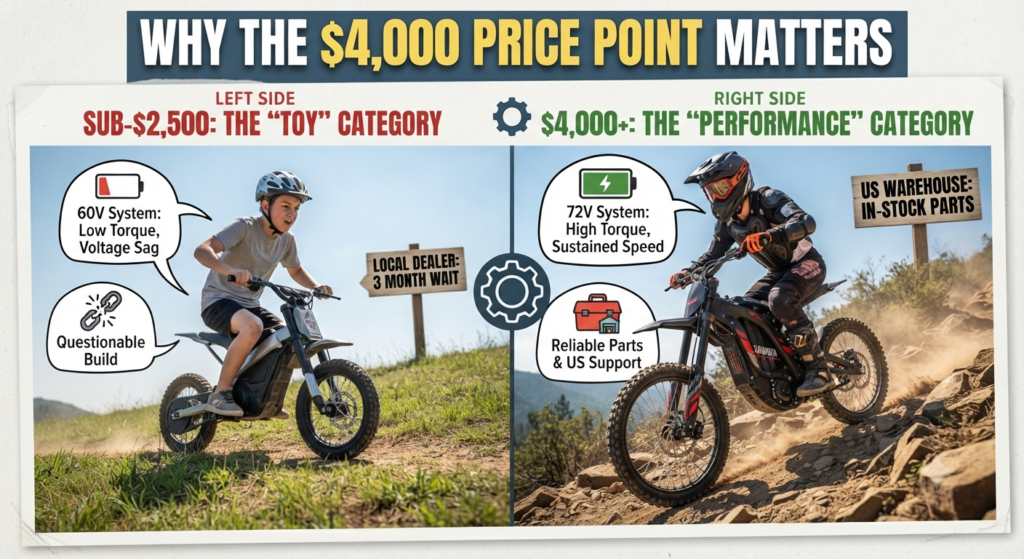
When shopping for an electric bike, it is easy to get distracted by flashy marketing. Many entry-level bikes look great on paper but fail under the stress of real-world trail riding.
A $4,000 budget allows you to step out of the “toy” category and into the “performance” category. At this price, you are looking for specific features that define a capable machine.
First, prioritize 72V battery systems. This is the new standard. It provides better acceleration and sustains higher speeds without the voltage sag common in older 60V models.
Second, consider component reliability. You want a bike that uses standard mountain bike or motorcycle parts for the brakes, tires, and suspension. This makes sourcing replacements much easier.
Finally, always prioritize US-based support. Never buy an e-moto from a brand that does not have a dedicated parts warehouse in the United States. You do not want to wait three months for a simple brake lever to arrive from overseas.
Top 5 Sur-Ron Alternatives Under $4,000
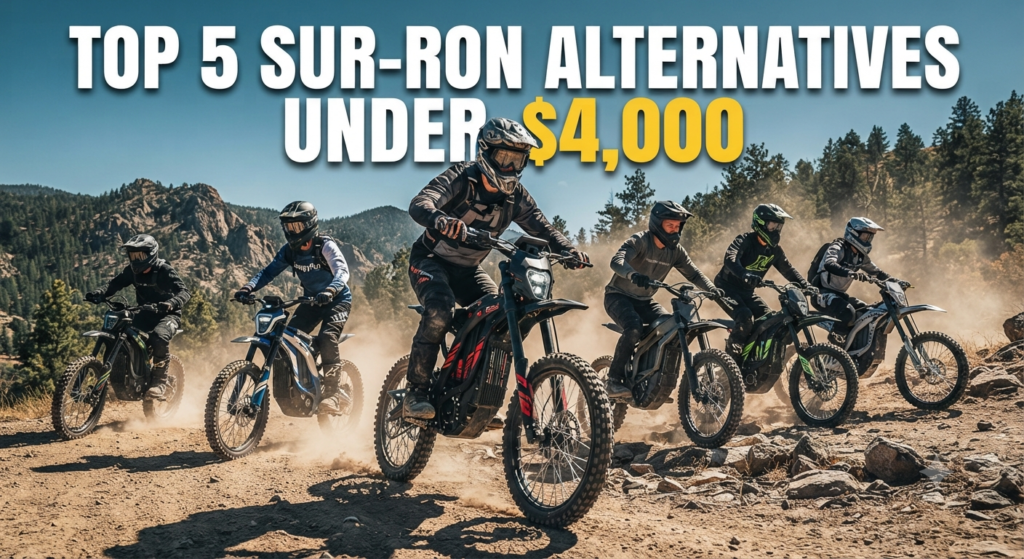
We have analyzed performance, rider feedback, and long-term durability to bring you these top contenders that currently dominate the market.
1. Rawrr Mantis X: The Disruptor
The Rawrr Mantis X has quickly become the go-to for riders who want Sur-Ron agility with more power. It is built to be a direct competitor, and in many ways, it feels more substantial on the trail.
Pros:
- True 72V power system that handles steep inclines effortlessly.
- Excellent frame geometry that makes jumps and technical terrain predictable.
- Very intuitive display and multiple customizable power modes.
Cons:
- Stock tires are better suited for light trails than deep mud or sand.
- It is noticeably heavier than a stock Sur-Ron Light Bee X, which affects flickability.
2. HappyRun G300 Pro: The Budget King
If you are a beginner or a casual trail rider, the HappyRun G300 Pro is an incredible value. It delivers surprising performance for a bike that often retails well under the $4,000 mark.
Pros:
- Aggressive pricing that leaves plenty of room in your budget for safety gear.
- Fully integrated lighting and turn signals for urban versatility.
- Very lightweight, making it easy to transport in a standard car rack.
Cons:
- Build quality is decent but not “pro-level” for extreme abuse or heavy jumping.
- Suspension is slightly stiffer than premium models, which can be harsh on rocky terrain.
3. Talaria Sting R (Used/Certified Pre-Owned)
The Talaria Sting R is widely considered the natural evolution of the e-moto market. While brand new models might stretch your budget, finding a well-maintained used unit is a goldmine.
Pros:
- Exceptional build quality and frame strength that rivals professional motocross bikes.
- Gearbox drive instead of a belt, which is much more durable and reliable.
- Massive aftermarket support for modifications like custom controllers and batteries.
Cons:
- Requires patience to find a reliable used unit without hidden mechanical issues.
- Maintenance on the gearbox requires specific oil changes that some beginners might find intimidating.
4. E-Ride Pro SS 2.0
The E-Ride Pro series took the market by storm by offering what most Sur-Ron owners had to spend thousands on aftermarket parts to achieve.
Pros:
- Incredible torque right out of the box, offering a thrilling ride experience.
- High-quality components used throughout the bike, from the forks to the brakes.
- Very fast top speed, making it suitable for larger trails and open areas.
Cons:
- It is a more aggressive ride, not ideal for complete beginners who are new to throttle control.
- Battery size is slightly smaller than the newer 3.0 version, though it is still very capable.
5. Arctic Leopard E-XC (The Hidden Gem)
This brand is gaining traction for its specialized off-road focus. It feels less like a commuter bike and more like a dedicated electric dirt bike.
Pros:
- Purpose-built suspension designed for serious off-road terrain.
- Better ground clearance than many of its competitors in this price bracket.
- Very responsive throttle control that feels crisp and natural.
Cons:
- Brand recognition is lower, which can make resale value a bit unpredictable.
- Parts availability can be slower compared to major players like Talaria or E-Ride.
Technical Considerations: What Matters Most?
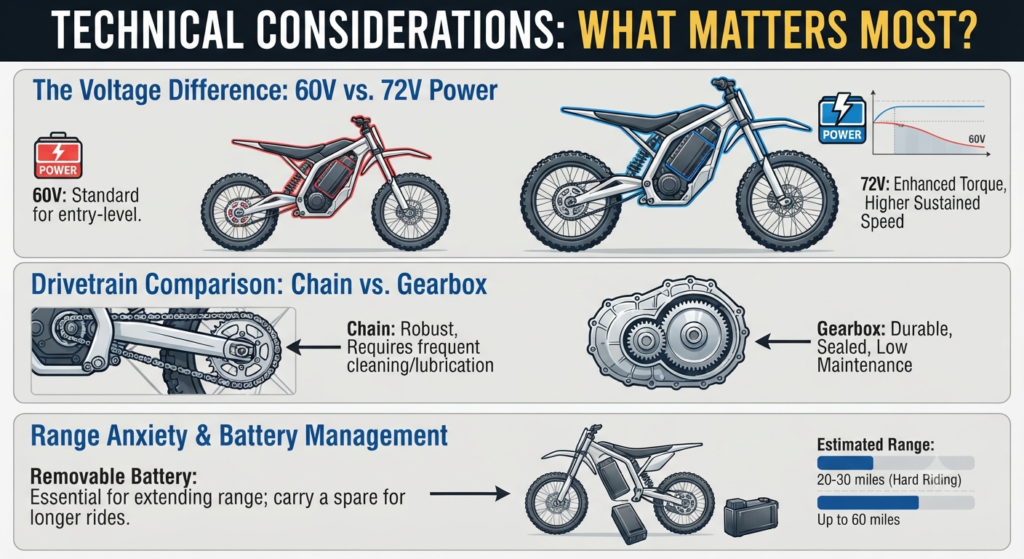
When comparing these bikes, do not just look at the top speed figures. You need to look at the total package to ensure you are getting a bike that suits your riding style.
The Voltage Difference
Voltage is the “horsepower” of the electric bike world. A 72V system allows the motor to pull more current without overheating as quickly as a 60V system. If you plan on riding hills, always prioritize a 72V system over a 60V one.
Belt vs. Chain vs. Gearbox
The original Sur-Ron used a belt drive, which is quiet but can snap under high load. Modern alternatives like the Talaria and Rawrr use gearboxes or chains. Chains are the most robust, but they require cleaning and lubrication after every ride to prevent premature wear.
Range Anxiety
Most manufacturers claim “up to 60 miles” of range. In the real world, if you are riding hard, expect 20 to 30 miles. If your commute or trail ride is longer than that, you must look for a bike with a removable battery so you can carry a spare.
Important: The Legal Reality
We cannot stress this enough: check your local laws before you buy. In most of the US, these bikes fall into a complex legal gray area.
Many states require these bikes to be registered if they are ridden on public roads. This means you may need a motorcycle license, insurance, and a license plate. If you ride them on public streets without these, you risk having the bike impounded by local authorities.
Always treat these as “off-road only” vehicles unless you have specifically titled and registered them for street use. Most riders prefer to use them on private tracks or designated off-road areas to avoid the headache of paperwork and legal compliance.
Maintenance and Ownership Costs
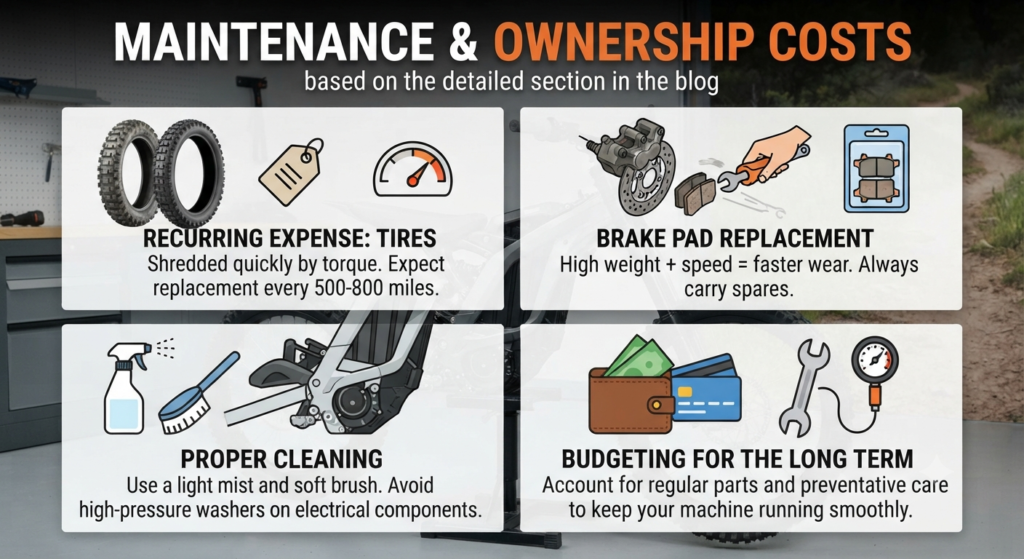
Buying the bike is just the first step. You need to budget for the long term to keep your machine running smoothly.
Tires are your first recurring expense. Electric dirt bikes shred rear tires quickly due to high instant torque. Expect to replace your rear tire every 500 to 800 miles of hard riding.
Brake pads are another critical item. Always carry a spare set. The weight of these bikes combined with high speed means you will go through pads much faster than on a regular mountain bike.
Cleaning is also vital. Never use a high-pressure washer directly on the motor or controller. Use a light misting of water and a soft brush to keep the electrical components safe and functional for years.
Final Verdict: Which One Is For You?
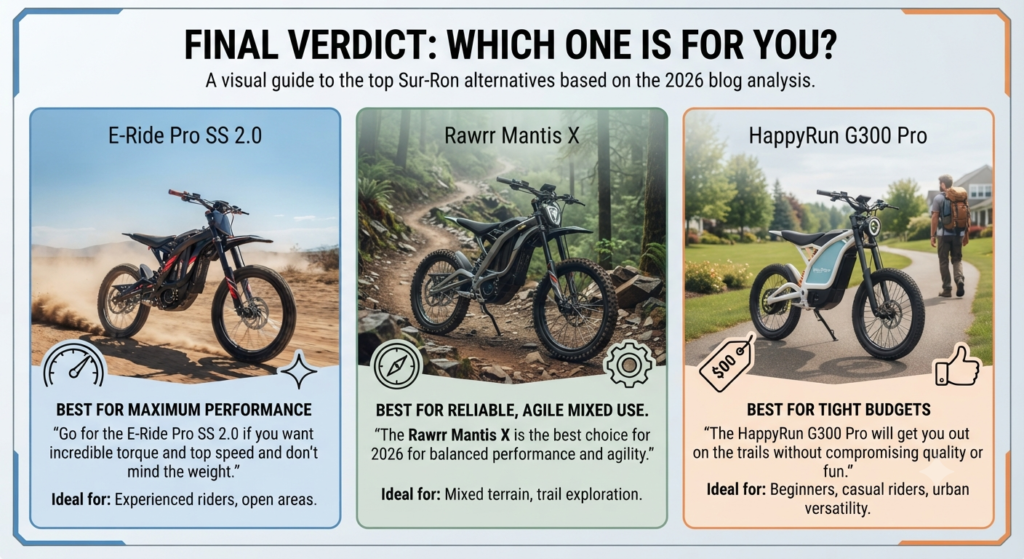
If you want the best performance and do not mind the weight, go for the E-Ride Pro SS 2.0. If you want a reliable, agile bike for mixed use, the Rawrr Mantis X is the best choice for 2026.
If you are on a tight budget, the HappyRun G300 Pro will get you out on the trails without forcing you to compromise on quality or fun.